

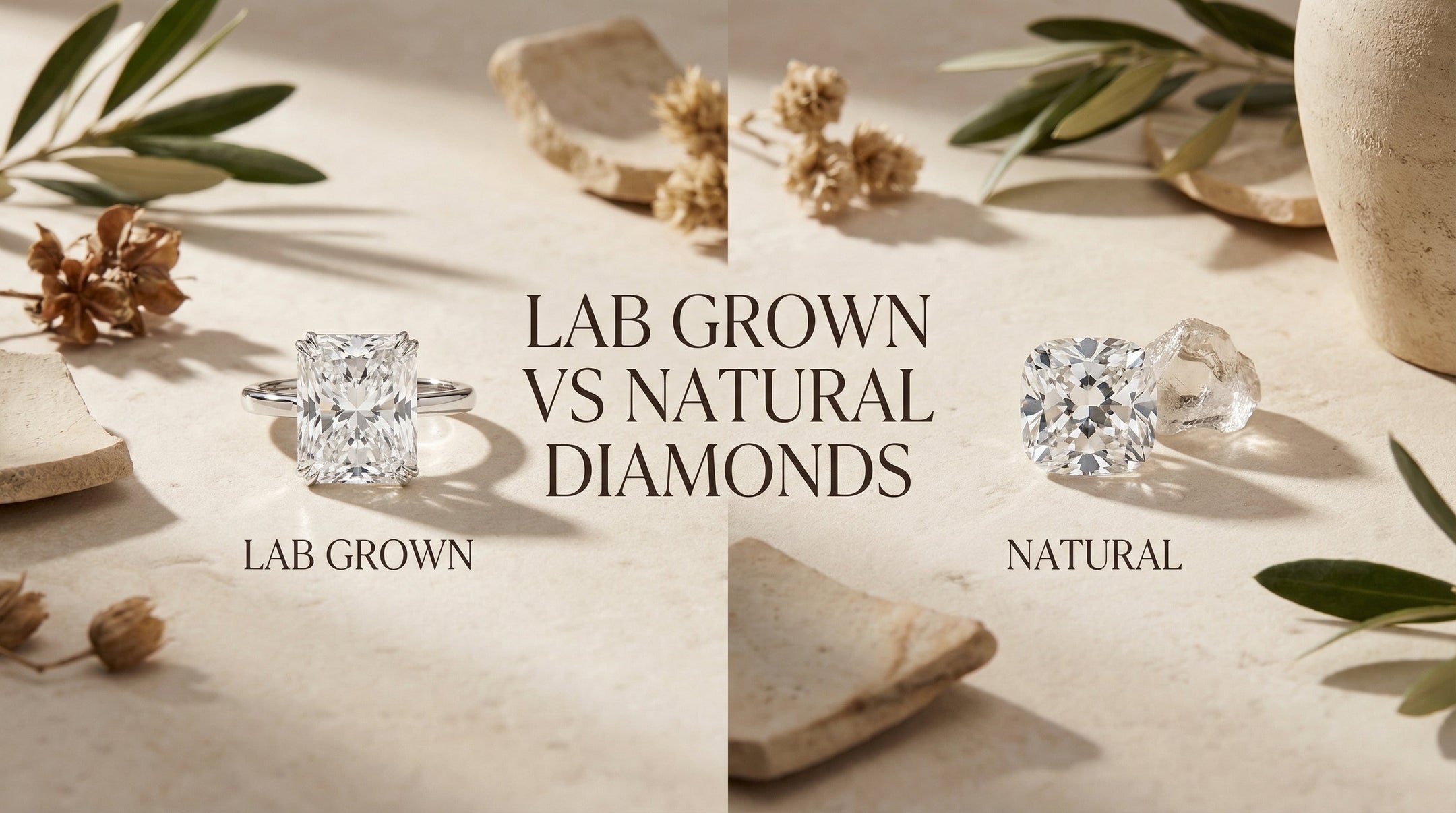
Lab Grown vs Natural Diamonds: What’s the Real Difference?
Introduction
If you’re shopping for an engagement ring, you’ve likely asked:
What’s the real difference between lab grown and natural diamonds?
The short answer?
They are chemically and visually identical.
The long answer?
There are meaningful differences in origin, market pricing behavior, and long-term considerations.
Let’s break it down clearly and objectively.
What Is a Natural Diamond?
A natural diamond forms underground over billions of years under extreme pressure and heat.
It is mined from the earth, then cut and polished.
Key characteristics:
-
Formed naturally in the earth
-
Geological rarity
-
Historically traditional choice
-
Long-established resale market
What Is a Lab Grown Diamond?
A lab grown diamond is created using advanced technology that replicates the earth’s natural growing conditions.
It is:
-
Chemically identical (pure carbon crystal)
-
Physically identical
-
Optically identical
-
Just as hard (10 on the Mohs scale)
It is not a simulant like cubic zirconia or moissanite.
It is a real diamond.
Lab vs Natural: Side-by-Side Comparison
|
Feature |
Lab Grown Diamond |
Natural Diamond |
|---|---|---|
|
Chemical Composition |
Carbon |
Carbon |
|
Hardness |
10 (Mohs scale) |
10 (Mohs scale) |
|
Visual Appearance |
Identical |
Identical |
|
Formation |
Created in controlled lab |
Formed in earth |
|
Geological Age |
Modern |
Billions of years |
|
Market Pricing |
Driven by production supply |
Driven by rarity |
|
Resale Market |
Developing |
Established |
Can You Tell the Difference?
To the naked eye:
No.
Even professional jewelers cannot visually distinguish them without advanced equipment.
Both can be certified by reputable labs like IGI or GIA.
How Pricing Works (Without Anchoring to Numbers)
Rather than specific dollar amounts, it’s more helpful to understand pricing structure.
Natural diamonds are priced based on:
-
Geological rarity
-
Mining supply
-
Historical demand
-
Brand markups
Lab diamonds are priced based on:
-
Production efficiency
-
Technology advancement
-
Supply expansion
-
Market competition
Because lab diamonds can be produced in controlled environments, their market pricing has adjusted over time.
For many couples, this allows for:
-
Larger carat weight
-
Higher color grades
-
Higher clarity grades
-
Within the same overall budget range

Environmental & Ethical Considerations
Natural diamonds today operate under regulated supply chains in major markets.
Lab diamonds avoid traditional mining.
For many couples, this becomes a values-based decision rather than a purely financial one.
Which Should You Choose?
Choose a lab diamond if:
-
You prioritize size and quality optimization
-
You prefer modern innovation
-
You value maximizing visual impact
Choose a natural diamond if:
-
Geological origin matters deeply to you
-
You value rarity history
-
Tradition is important to your story
Final Thoughts
Both are real diamonds.
The better choice depends on your values, not marketing narratives.
At Genesis Stones, we guide couples through both options transparently so they can make confident decisions.

